
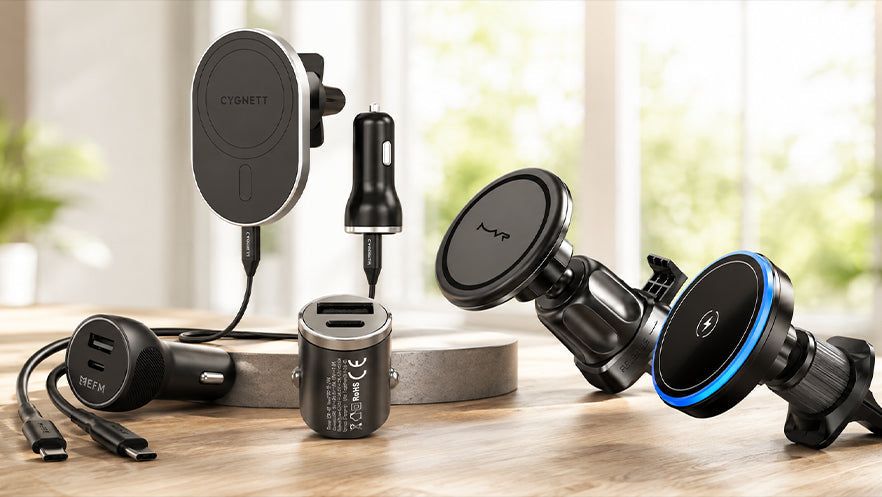
Introduction
Is a wireless car charger really as fast as a wired one?
It's one of the first questions drivers ask before buying a new car charger. The answer is simpler than it sounds, and once you know how each type works, the right pick becomes easy.
In this guide, we compare wireless vs wired car chargers side by side. We'll explain how each one powers your phone, which one is faster, and which suits your daily drive best. You'll also find real wireless and wired car charger options you can use straight away.
How Does Charging Speed Actually Work?
Every charger sends power to your phone in watts. The higher the wattage, the faster your phone charges. A wired charger sends this power straight through a cable, so almost none of it is lost along the way.
A wireless charger sends power through the air using magnets and coils instead of a cable. Some of that power turns into heat instead of battery charge. That's the main reason wired charging is usually a little quicker.
This is like putting water in a cup. A cable is a hose pointed straight into the cup. Wireless charging is more like pouring water through a small gap in the air. A little water always lands outside the cup.
Wireless Car Chargers: How They Work
In a wireless car charger, there is a coil inside the charging pad. Your phone also has a coil that works with it. When the two coils line up, power flows between them with no cable needed. Most wireless car chargers use the Qi charging standard, which most new phones already support.
The one thing wireless charging needs is good alignment. If your phone shifts even slightly on a bumpy road, charging can slow down or stop. That's why wireless car chargers have strong magnets that hold your phone like MagSafe.
Wireless charging still wins on convenience. You simply place your phone on the mount, and it starts charging and holding your phone steady at the same time. There's no cable to plug in, and no cable to snap or fray over time.
Our Pick of the Best Wireless Car Chargers
If you'd rather not have any cords on your dashboard, these wireless chargers are a great cable-free option.
-

Beetle
Beetle R8 MagSafe Wireless Car Charger – Black | Fast Charging Magnetic Holder with 360° Rotation
In stockRegular price $59.95Unit price -


 30% off
MVR
MVR T5 MagSafe Car Charger - Black | 360° Rotating, 15W Fast Charge Wireless Phone Holder
In stockSale price $41.97 Regular price $59.95Unit price


-
 50% off
EFM
EFM 57W Car Charger – Black | Dual Port Series with Type-C Cable Fast, Durable & Compact Charging
Very low stockSale price $34.95 Regular price $69.95Unit price -


 30% off
MVR
MVR Car Charger - Dual USB Quick Charge 3.0 & PD 48W Fast Charging Adapter
In stockSale price $20.97 Regular price $29.95Unit price


Wireless vs Wired Car Chargers: Quick Comparison
|
Feature |
Wireless Car Charger |
Wired Car Charger |
|
Charging speed |
Slightly slower |
Usually faster |
|
Convenience |
No cable, just place and go |
Needs a cable connection |
|
Long-term wear |
Coil and magnet, no cable to fray |
Cable can wear out over time |
|
Phone case compatibility |
Works best with thin, MagSafe-friendly cases |
Works with any case |
|
Best for |
Daily commutes, hands-free calls and maps |
Long trips, tablets, faster top-ups |
Which One Should You Choose?
If you just drive around town a lot and want to keep your charger clean and cord-free, wireless charger is a great option. You can put your phone down and it will hold it and charge at the same time.
Often, a wired charger will win out if you're relying on GPS a lot, driving long distances, or need to charge a tablet alongside your phone. A lot of drivers keep both, one for everyday use, one for road trips.
Keeping It Legal and Safe While You Drive
However you charge your phone, how you mount it matters just as much as how fast it charges. Picture being stuck in traffic on the M1 during a Melbourne heatwave, phone sliding around on the seat because it isn't mounted properly.
That's exactly the situation a good car charger and holder is meant to prevent. Under Victoria's road rules, administered by the Department of Transport and Planning, a fully licensed driver can only use a mobile phone while driving if it's secured in a holder that's commercially designed and manufactured for that purpose, not resting on the dashboard or in your lap.
Learner and P-plate drivers face much stricter rules and generally can't use a mobile device at all while driving, even if it's mounted. Rules for mounted devices are broadly similar across other states, so it's worth checking your own state's road rules before you drive off.
This is another reason a proper magnetic or vent-mounted charger is worth having. It keeps your phone secure, charged, and within the rules, all at once.
It's also worth noting that the energy efficiency of external power supplies, including phone chargers, is regulated under the Greenhouse and Energy Minimum Standards Act, as outlined on the Australian Government's Energy Rating website. This is part of why modern chargers run cooler and more efficiently than older models.
The Bottom Line
Because the cable is straight, there is less energy lost along the way, so wired chargers tend to charge a little faster. Wireless chargers trade a small amount of speed for a cleaner, cable-free setup and a built-in mount that holds your phone steady.
Neither option is wrong. It comes down to how you drive, how you use your phone in the car, and how much you value convenience over raw speed. Whichever you choose, pick a charger built by a trusted brand, mounted properly, and suited to how you actually drive.
Ready to upgrade your car charging setup? Browse the full wireless and wired car charger range at Mobile Experts Online Store and find the option that fits your car and your phone.
